
Introduction: The Genesis of a New Artistic Era
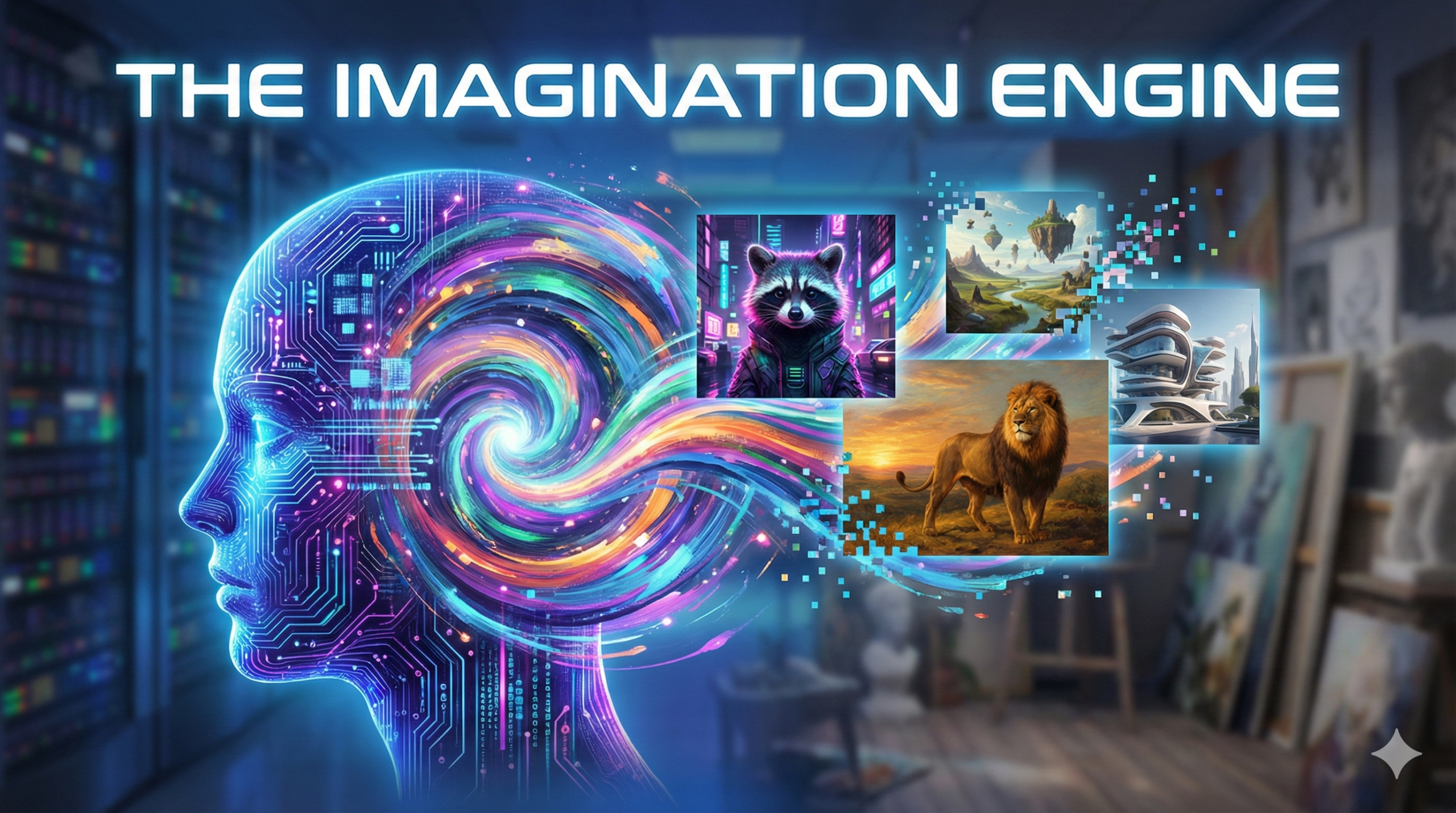
Three years ago, if you wanted a photorealistic image of “a cyberpunk raccoon sipping coffee in a neon-lit Tokyo ramen bar,” you had two options: spend years mastering complex digital painting software or commission a professional artist and wait weeks.
Today, you can have that exact image in under thirty seconds.
We are currently living through one of the most profound technological shifts since the invention of photography. Artificial Intelligence AI image generation—the ability of a machine to create visuals from simple text prompts—has graduated from a niche research curiosity into a global cultural phenomenon. It is changing how marketers brainstorm, how game designers concept new worlds, how internet culture generates memes, and fundamentally, how we define “art.”
But like any disruptive technology, this power comes with complexity. It brings immense creative liberation, but it also carries significant ethical baggage regarding copyright, misinformation, and the future of human labor. This is a deep dive into the world of AI image generation: how it works, who the major players are, and the seismic impact it’s having on our visual reality.
The Ghost in the Machine: How Does it Work?

To the uninitiated, typing words into a box and getting a stunning image out feels like pure magic. But beneath the hood, it is a triumph of mathematics, massive datasets, and innovative neural network architectures.
While there are various methods, the current gold standard driving tools like Midjourney and DALL-E 3 is known as the Diffusion Model.
To understand diffusion, forget the idea that the AI is “collaging” existing images together. It’s not. Instead, think of it as a master restorer working in reverse.
During its training phase, the AI is shown billions of images—photos, paintings, diagrams—scraped from the internet. Each image is paired with a text description. The training process involves taking a clear image and gradually adding mathematical “noise” (like static on an old TV) until the image is just pure, unrecognizable chaos. The AI’s job is to learn how to reverse that process—to look at the static and predict what the original image was, step by step, denoise it back into clarity.
When you give the AI a prompt like “a majestic lion at sunset,” it doesn’t search for a lion photo. It starts with a canvas of pure static noise. Guided by its understanding of the concepts “majestic,” “lion,” and “sunset” gained during training, it begins to hallucinate patterns in the noise. Over dozens of iterative steps, it refines that static, removing the noise that doesn’t look like a lion at sunset and keeping the noise that does, until a brand-new, never-before-seen image emerges.
The Titans of Text-to-Image

The landscape of AI generators is moving at breakneck speed, but currently, four major players define the space, each with a different philosophy.
1. Midjourney: Currently the reigning champion of aesthetics, Midjourney is famous for its distinct, painterly, and highly artistic style. It often defaults to images that look incredibly dramatic and visually rich. It operates entirely within the chat app Discord, which gives it a steeper learning curve but fosters a massive, collaborative community of prompters.
2. OpenAI’s DALL-E 3: Integrated directly into ChatGPT, DALL-E 3’s superpower is coherence and ease of use. While Midjourney might struggle to place text in an image or count objects correctly, DALL-E 3 is exceptionally good at understanding complex, multi-part instructions and rendering exactly what you asked for, including readable text on signs.
3. Stable Diffusion (by Stability AI): The champion of the open-source community. Unlike its competitors, Stable Diffusion’s models can be downloaded and run locally on your own powerful computer. This means no censorship filters, total privacy, and the ability to fine-tune the model on your own images. It is the engine behind countless third-party apps and creative experiments.
4. Adobe Firefly: The “professional’s choice.” Adobe built Firefly to be integrated directly into tools like Photoshop. Its main selling point is ethics and commercial safety; Adobe claims Firefly is trained primarily on Adobe Stock images and public domain content, theoretically reducing the risk of copyright infringement for commercial users.
The Creative Revolution: Practical Use Cases

Beyond generating surreal internet memes, AI image generation is rapidly integrating into professional workflows.
- Concept Art and Storyboarding: Filmmakers and game developers use AI to rapidly iterate on visual ideas. Instead of a concept artist taking two days to sketch a single environment, they can generate fifty variations in an hour to establish the mood before committing to final assets.
- Marketing and Advertising: Agencies are using AI to create mockups for ad campaigns and generate hyper-specific stock imagery that doesn’t exist in traditional libraries.
- Architecture and Interior Design: Designers can take a rough sketch of a room and use AI to render it in twenty different styles—minimalist, bohemian, industrial—instantly showing clients the possibilities.
The Elephant in the Room: Ethics and Controversy

We cannot discuss the awe of this technology without addressing the significant shadows it casts. The rapid adoption of AI image generation has outpaced our legal frameworks and ethical guidelines.
The Copyright Crisis: This is the biggest battleground. The datasets these AI models train on contain billions of copyrighted images created by human artists, usually scraped without permission or compensation. Many artists feel their life’s work has been fed into a machine that can now mimic their style instantly, threatening their livelihood. Several high-profile lawsuits are currently working through the courts that could decide the future legality of generative AI.
The Erosion of Reality (Deepfakes): In 2023, an image of Pope Francis wearing a stylish, puffy white Balenciaga jacket went viral. It was fake, created by Midjourney. While harmless, it was a wake-up call. As these tools become capable of photorealism, distinguishing truth from fabrication becomes incredibly difficult. This has terrifying implications for political misinformation, non-consensual explicit imagery, and the general erosion of trust in photographic evidence.
Bias and Representation: Because AI models learn from the internet, they learn the internet’s biases. Early versions of these models would overwhelmingly show white men if asked for a “CEO,” or default to stereotypes when asked for images of certain cultures. While companies are working hard to “steer” models toward better representation, the underlying bias of the training data remains a persistent challenge.
The Future Outlook
We are only in the infancy of this technology. The still image was just step one.
We are already seeing the rapid emergence of generative video with tools like OpenAI’s Sora and Runway Gen-3. Soon, we will move from text-to-image to text-to-world, where entire interactive 3D environments for video games or virtual reality are generated on the fly by AI.
The future of creativity is likely hybrid. AI won’t replace human imagination, but it will act as the ultimate force multiplier for it. The artists of the future will be master conductors, guiding these powerful synthetic orchestras to create visions we can currently barely imagine. The genie is out of the bottle; the challenge now is learning how to wield it responsibly.
For more content like this, check out my blogs.